Markets
How to Read a Farmers Market Like a Chef
A chef-style walk through a market morning: when to arrive, how to read a stall, what to ask growers, and how to build dinner from whatever looks best.

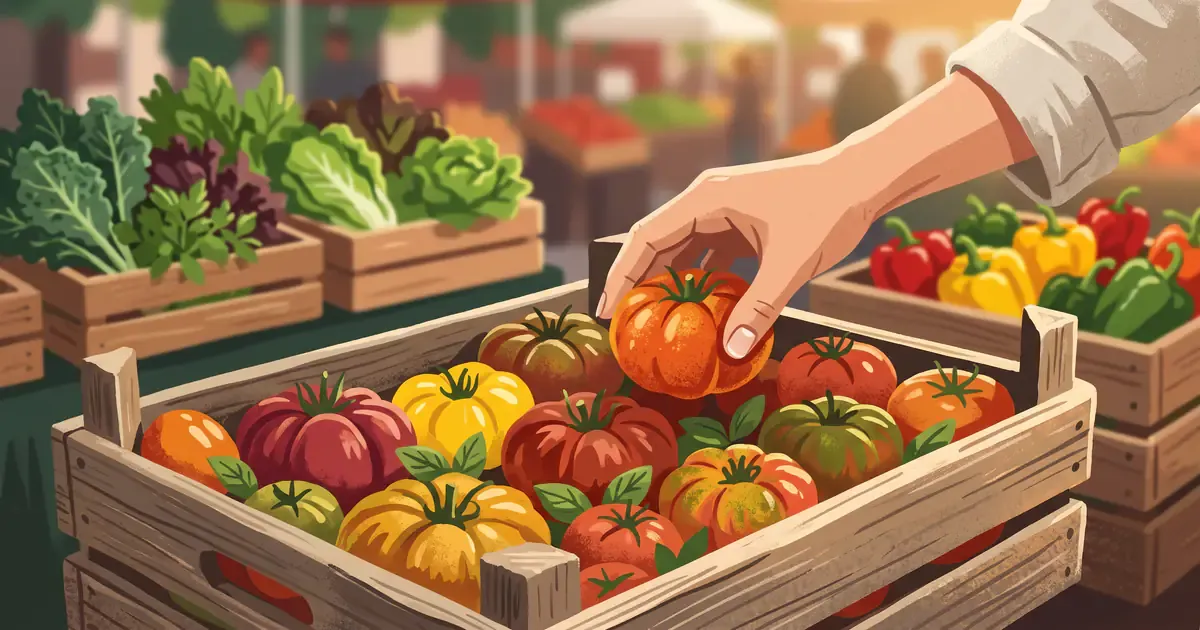
A chef walks into a market and doesn’t start buying. She walks the whole thing first, looks at every table, talks to two or three people, and then goes back to the stall she liked best. By the time she pulls out cash, dinner is already decided.
You can do the same thing on a Saturday morning with a tote bag and no professional training. Most of it is attention: to what is on the table, to what is missing from it, and to the person standing behind it. Here’s how a market morning works when you treat it like a kitchen instead of a shopping trip.
Arrive early, or arrive late, but know why
The first hour and the last hour are two different markets. Neither one is wrong. They are just good for different things.
The case for the first hour
Selection is the obvious reason. The best tomatoes, the good eggs, the one bunch of the herb you came for: all of it goes early. The quieter reason is that vendors have time. At opening, a grower will talk to you about what is good, what is coming next week, and how to cook the thing you are holding. By mid-morning there is a line, and the conversation gets shorter.
Early is also when you see a market at its most honest. Crates are full, the display has not been rearranged, and you can tell what a farm actually brought that day.
The case for the last hour
Late is for bargains and for people who do not mind a little chaos. Some vendors would rather sell the rest of a crop than pack it back into the truck, so the final hour is when a deal is most likely. It is also when the selection is picked over, which means you should arrive with a flexible plan. If you are cooking for a crowd or making sauce, late is a fine bet. If you want the best of one specific thing, it isn’t.
What to bring before either
Cash in small bills, because not every vendor takes a card and nobody loves making change for a twenty at eight in the morning. Your own bags: one sturdy, one soft for delicate things. A cooler in summer if you are buying meat, dairy, or fish. And a little patience for the person in front of you.
Walk the whole market before you buy anything
The first lap is reconnaissance, not shopping. Walk past the first stall without stopping, even if it looks wonderful, and keep going until you have seen everything. You are building a map: who has tomatoes, who has the good bread, who is selling greens that look tired, who has a line and why.
This matters because markets are not uniform. Two farms can bring the same crop at different quality and different prices, and the first table you see is rarely the best one. On the second lap you buy, and you buy from the people whose tables held up when you compared them.
Chefs call this a walk-through, and they do it before service for the same reason. You can’t plan a menu until you know what’s in the kitchen.
Every market runs on its own rules and its own rhythm, and the markets archive is a good place to compare notes before you set out.
How to tell what is local and what is in season
Most markets have rules about who can sell, and many require that vendors grow what they sell. Not all of them do. That doesn’t make a reseller a villain. It does mean you should know what you are buying.
The simplest question is also the most direct: did you grow this? A grower answers immediately. Someone selling on behalf of a farm will tell you which farm. Someone who didn’t grow it will often change the subject, and that is your answer.
Then look at the table itself. Variety is the strongest signal. A stall with six kinds of tomato, three kinds of bean, and herbs you do not recognize is almost certainly a farm that plants for flavor. A stall with one perfect, uniform pile of the same tomato in April, in a cold climate, probably is not.
| What you see | What it usually means | Worth asking |
|---|---|---|
| Many varieties of one crop | A grower planting for flavor, not volume | Which one do you like best? |
| Shallow crates, nothing stacked high | Produce handled gently, likely grown by the seller | Did you grow this? |
| Dirt, roots, and stems still on | Less processing, usually fresher | How long will this keep? |
| Uniform, waxed, identical sizing | Packed for shipping, possibly resold | Where was this grown? |
| Small quantities and gaps on the table | A small grower selling what ripened | What is coming next week? |
| Blemished or split fruit set aside | Seconds, best for sauce or jam | Do you have a box of seconds? |
Off-season is not a crime
Greenhouse greens in February are local and real. Storage apples in March are local and real. A tomato in January in Minnesota is neither, and if a stall has one, it traveled. Buy it if you want it. Just do not pay farmers market prices for supermarket produce without noticing. If you are not sure what should be in season right now, our month-by-month produce calendar is a quick check.
Questions that get a real answer
Vendors answer hundreds of questions in a morning. The ones that get a genuine response are short, specific, and about the food.
The short list
- What is best today?
- What did you pick this morning?
- How would you cook this?
- How long will this keep?
- Is this the start of the season or the end of it?
- Do you have any seconds?
Asking without interrogating
Wait until the person ahead of you is finished. Ask one question, not five. Don’t ask a farmer to justify their prices at the busiest moment of the week. If you want a longer conversation, come back near the end of the morning, when the rush is over and the grower is packing up and happy to talk. If they give you a cooking suggestion, take it, then tell them how it turned out the following week. That is how a transaction turns into a relationship.
Seconds, and why chefs ask for them
Seconds are the produce that did not make the display: split tomatoes, small or oversized squash, bruised peaches, beans a day past their best, peppers with a soft spot. They taste the same. They just will not sit on a table looking perfect, so they get set aside and often sold for less.
Chefs buy them constantly, because a kitchen is going to cut them up anyway. Ask for them directly. “Do you have any seconds?” is a normal question, not an insult, and plenty of vendors keep a box under the table for exactly this reason.
Use them the day you get them. Tomatoes become sauce, peaches become jam or a crumble, peppers get roasted, squash gets soup, and anything too far gone goes into stock or the compost.
Build a meal from what is there, then come back next week
The most common mistake is arriving with a recipe and a shopping list. You will spend the morning hunting for things that are not there and walk right past the things that are.
Instead, bring a rough idea and a pantry. If you have olive oil, garlic, onions, pasta or rice, eggs, a hard cheese, and something acidic at home, you can build dinner around almost anything you find. Buy the three best things at the market and let them decide the rest.
A market meal might be a pile of peppers roasted with garlic and spooned onto bread. It might be squash soup with the last apples of the season on the side. It might be nothing but tomatoes, salt, and good bread, eaten standing up over the sink. All of those beat a recipe followed badly with mediocre ingredients.
Carry cash, bring bags, and come back
Cash is faster and friendlier, and small bills make change easy. Bring your own bags, and don’t handle produce you aren’t going to buy. Say thank you on the way out. Then come back next week, to the same market, and buy from the same people. This is the part that matters more than any technique: a market rewards the people who show up. Vendors learn your face, set aside the thing you liked, and tell you what is coming. That is not a discount. It is something better.
A market is a habit, not an outing
You don’t need to be a chef or a regular to shop well. You need a walk-through, a few honest questions, and enough flexibility to let the table decide dinner. Go this weekend, buy a little less than you think you need, and cook it that night. Then go back and do it again. For more market guides, browse the blog, and check our city guides for markets and farm stands near you.
Keep reading
Three more guides
 Late-Night Food: How to Find What's Open How to find good food after 10pm: check whether the kitchen is still serving, know which places hold up, order well at close, and get home safely.
 Tipping at Food Trucks, Counters and Markets How tipping works at food trucks, counters and farmers markets: the jar, the card reader prompt, when it is customary, and how to keep it simple.
 How to Find the Best Food Trucks in Any City A practical field guide to finding the best food trucks in any city: what to look for before you order, where trucks really park, and a ten-minute routine.