Food Trucks
Tipping at Food Trucks, Counters and Markets
How tipping works at food trucks, counters and farmers markets: the jar, the card reader prompt, when it is customary, and how to keep it simple.

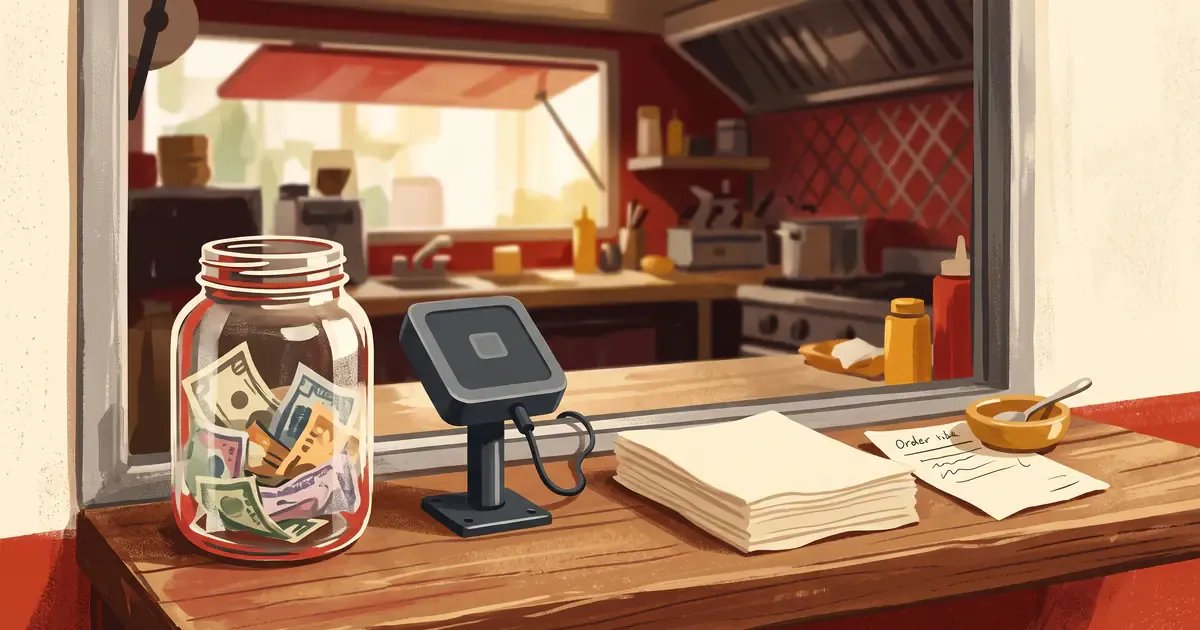
A tip at a food truck is a small amount of money attached to a surprising amount of social uncertainty. The jar is there, the card reader is about to ask, and nobody wants to be the person who makes lunch weird.
Here is how tipping actually works at trucks, counters and market stalls in the US, including the parts nobody explains: why the prompt appears, where the money goes, what to do when your pockets are empty, and how to be generous without turning it into a performance. We spend a lot of time at truck windows for our food truck coverage, and this question comes up constantly.
What a Tip at a Truck Is Actually For
On a truck, the person handing you your change is often the person who owns the thing, or their partner, or a friend who works the window on Saturdays. That changes what a tip means. It is not a line item in a corporate budget. It is a direct thank-you, plus a little cushion for a business with thin margins, weather-dependent sales, and no dining room to fill.
How the money gets split varies. Some crews pool tips and divide them at the end of the shift. Some hand the jar to whoever worked the window. You do not need to audit any of it before you order, but it helps to know that a tip is a gesture between people, not a fee.
There is a practical side too. A jar of small bills is a working float for change, and a truck that runs out early in service has a harder afternoon. If you have a choice between a large bill and something smaller, the smaller one is often more useful.
And a tip is not a moral test. Staff are paid a wage, however imperfect, and a truck does not stay open because you dropped some change in a jar. It stays open because the food is good and the schedule works.
Three Places You Will Meet a Tip Jar
At the truck window
The jar is usually taped to the counter, sitting next to the card reader, or clipped to the window frame. This is the most casual tipping moment in food. You ordered standing, you are taking the food with you, and nobody is going to count what you leave. Card tips are common now; cash still moves faster into a hand.
At the counter
Coffee shops, taquerias, slice shops, delis, bakeries with four stools. You order at a register, carry your own tray, and clear your own table. Tipping here is customary in a lot of places but smaller than what you would leave at a table with a server, because the work is different. Some counters split tips across the whole crew; some keep a single jar for the person on register.
At the market stall
Farmers markets sell two different things under one tent roof. One stall is selling groceries: tomatoes, eggs, a bag of peaches. Another is selling you lunch: a griddle, a folding table, a line of people waiting for something hot. The first is a retail purchase. The second is cooking, and cooking is what tips are for. If you want to shop the stalls with more confidence, our guide to reading a farmers market covers the rest.
| Where you are | Is a tip expected? | What it usually looks like |
|---|---|---|
| Truck window | Customary, not required | Change in the jar or a small add-on on the card reader |
| Counter where you order and sit | Customary, usually modest | The jar, or the lowest option on the screen |
| Full-service table | Expected, part of how staff are paid | A percentage of the bill, cash or card |
| Market produce stall | Not expected | Nothing beyond the price of the produce |
| Market prepared-food stand | Appreciated | Jar change or a card add-on |
| Festival or pop-up booth | Appreciated, not assumed | Whatever you would leave at a truck |
When a Tip Is Customary and When It Is Optional
Counter service versus full service
Full service means someone took your order, brought your food, refilled your water, and cleared your plates. Tipping is baked into how that job pays, which is why skipping it lands differently. Counter service means you did most of the moving parts yourself. A tip is a thank-you for the cooking and the speed, and it is genuinely optional, even when the screen offers it.
Buying produce versus buying a meal
At a produce stall you are buying ingredients. The farmer’s margin is in the vegetable, not in your generosity, and nobody at that table is expecting a tip for handing you a paper bag. At a prepared-food stand, someone hauled a griddle into a parking lot, cooked in the open, and washed up in a bucket. That is restaurant work without a restaurant, and a tip recognizes it.
Norms vary, and so do budgets
Tipping customs are regional, and they shift by neighborhood and by type of business. Watch what the person ahead of you does; it is the most reliable local signal available. And if your budget is tight this week, that is a real thing. Ordering from a small truck at all is support. Nobody behind the counter is grading you.
If a tip is genuinely not in the budget, order what you can afford and leave the guilt out of it. A truck would rather have your order than your apology.
The Screen Flip, Card Fees, and the Tip Pool
The card reader turns around with suggested amounts. Those suggestions are settings chosen by the business, not a rule and not a test. Choosing a custom amount, the lowest option, or nothing at all is a normal thing to do, and the person at the window has watched a thousand people do it.
Where the money lands is worth understanding. Card tips are usually recorded in the payment system and paid out later, often through payroll, and card processing costs come off the top somewhere in that chain. Cash tips tend to go into a jar and get split at the end of the shift, sometimes the same night. Neither arrangement is shady; it is bookkeeping, and small operators deal with it every day.
If you want your tip to reach a hand today, cash does that most directly. If you do not carry cash, a card tip still counts and still helps. Do not assume the owner keeps it all, and do not assume the crew gets every cent. You can ask, politely, but you do not have to.
Some crews watch the screen out of habit. Most never look. Either way, the number you choose is between you and the machine, and it is not a verdict on your character.
What to Do When You Have No Cash
This happens constantly, and it is not a crisis. Add a small amount on the card reader and move on. Round up if the screen allows a custom number. Say thank you like you mean it. Come back with cash next time, especially if the truck is a regular stop.
What not to do: apologize for three minutes, announce that you always carry cash, or promise a tip you both know is theoretical. The crew has a line behind you. A short “next time” is enough.
If there is no card option for tips at all and the jar is the only route, a clean table and a genuine compliment are not nothing. They are also not money, so tip on the next visit if you can.
Tipping Without the Awkwardness
Decide before you reach the window. Fumbling with the screen while a line waits behind you is the most uncomfortable version of this, and it is entirely avoidable.
Do not narrate. A running commentary on tipping culture, wages, or your own generosity turns a two-second exchange into a lecture the crew did not ask for. Save it for the walk home.
Match your budget, not the screen. Suggested amounts are suggestions. A small tip given easily is worth more to the mood of a service window than a large one given with a sigh.
Tip for the service you actually got. If the food came fast and the order was right, say so with money if you have it. If something went wrong and they fixed it without drama, that is worth recognizing too.
Be consistent with regulars. The truck you visit every week is where a habit of tipping, or not, becomes visible. Either is fine. Just be the same person each time.
If you are splitting a group order, tip once on the whole thing rather than leaving four people to each add a little. One clear amount is easier for a crew to handle than a pile of tiny transactions.
The Short Version
Nobody is keeping score, and nobody expects a speech. Tip when you can, in whatever amount fits, and skip it without guilt when you cannot. If you are new to a city, our city guides will point you toward the trucks and markets worth the trip. More of this lives on the blog.
Keep reading
Three more guides
 How to Find the Best Food Trucks in Any City A practical field guide to finding the best food trucks in any city: what to look for before you order, where trucks really park, and a ten-minute routine.
 Late-Night Food: How to Find What's Open How to find good food after 10pm: check whether the kitchen is still serving, know which places hold up, order well at close, and get home safely.
 How to Read a Farmers Market Like a Chef A chef-style walk through a market morning: when to arrive, how to read a stall, what to ask growers, and how to build dinner from whatever looks best.